Sunday, 18 December 2011

Darwin, Hamilton Smith and the Lost Domestications of South America

Theories of canine domestication are beginning to take into account partial domestications of wolves, such as the 33,000 year old skeleton from a Siberian cave described by Ovodov et al. (2010), and the skull from a cave in Belgium described by Germonpre et al. (2009). Ovodov et al. argue:

�Since dog domestication almost certainly occurred multiple times without direct human selection, we suggest that it must have occasionally failed. That is, the particular set of ecological conditions associated with human settlement and hunting practices that were necessary to initiate the domestication process must have, on some occasions, existed only long enough to produce a few modified wolves (i.e., incipient dogs) with short-lived lineages.�

These researchers suggest that �ecological changes caused by progressive cooling almost certainly caused social and settlement pattern changes severe enough to have disrupted the domestication process and prevented evolution of fully domesticated dogs.� They see their results as supporting a multiple-domestication-events hypothesis for Canis familiaris.

That domestication could occur within the canid family, the Canidae, but outside the genus Canis, was demonstrated by the work of of Belyaev (1979) and his students, particularly Trut (1999), who artificially domesticated silver foxes (Vulpes vulpes), through selective breeding over 30 to 35 generations. The experiment, which continues, left open the question of whether foxes could be domesticated outside of such an experimental environment.

In the 1830s, Charles Hamilton Smith observed canids in South American that were living with indigenous peoples and performing some domesticated functions for them. In one instance, Smith suggested that some apparently different species might actually be tame and wild versions of a single species, raising the possibility that some physical differences could have begun to occur because of the domesticated state. Recent research on pointing gestures with a South American canid closely related to some of the species observed by Smith may also indicate that these lost domestications involved more behavioral change than has previously been recognized.

South American Canids Described by Naturalists in the 19th Century

Charles Hamilton Smith, after discussing the maned aguara (labeled Chrysocyon jubatus by Smith but now generally called Chrysocyon brachyurus) the largest of the South American canids he had encountered, makes some general remarks regarding the animals he will discuss in the following chapters:

�South America, when first discovered by the Spaniards, was possessed of canines absolutely indigenous, some universally wild and others liable to be partially reclaimed; all more nocturnal than the former dogs and less so than the true foxes.�

The first plate is Smith's depiction of the maned aguara. (Double click to enlarge image.) Smith suggests that the name aguara (sometimes transliterated as warrah), attached to so many of these species, may come from the sound they make, �a loud and repeated drawling cry, sounding like a-gou-a-a-a, which is heard to a considerable distance.� (Smith's drawing does not show the ratio of leg length to torso size apparent in pictures of maned wolves, suggesting they may not have been seen often at close range.)

Genetics research, as will be discussed later, has recently indicated that some of the South American canids had a North American origin, but the biological significance of the formation of the isthmus of Panama, the Great American Interchange, was not yet understood. Smith says the maned aguara, the first plate included here from Dogs: Canidae or Genus Canis of Authors, was wild, but records that he had seen various levels of domestication in the other canids:

�Several can be sufficiently tamed to accompany their masters to hunt in the forest, without however being able to undergo much fatigue; for, when they find the sport not to their liking, they return home to await the return of the sportsmen. In domesticity they are excessive thieves, and go to prowl in the forest. There is a particular and characteristic instinct about them to steal and secrete objects that attract their attention, without being excited by any well ascertained motive. All subsist upon the usual food of the wild canines, but with the addition that they eat also fish, crabs, limpets, lizards, toads, serpents, and insects. They are in general silent and often dumb animals; the cry of some is seldom and but faintly heard in the night, and in domestication often learn a kind of barking. None appear to be gregarious, but several are occasionally encountered in families. Although in company with man, the domesticated will eagerly join in the chase of the jaguar, we have never heard that they are in the same state of hostility towards feline as are their congeners in Asia and Africa.�

Smith then states that in the 35 years before completion of his great study of dogs, the natives of South American had shown a distinct preference for European dogs, so that it was by 1839 difficult to find any indigenous dogs associated with them �even in the more remote parts of the interior.�

Hoary Aguara Dog/Fox
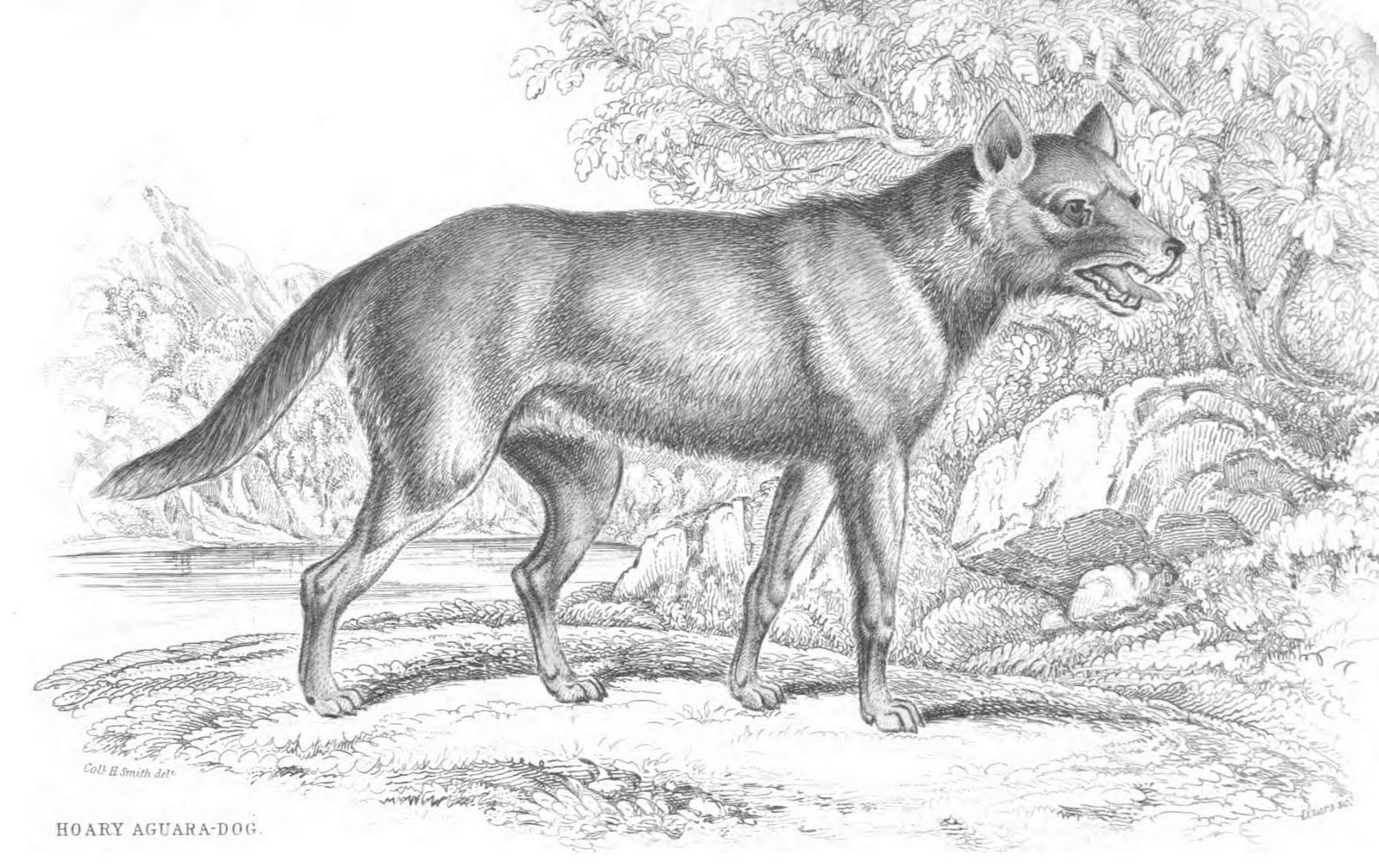
The hoary aguara dog was labeled Dusicyon canescens by Smith, but is now generally put in a more fox-like genus and classified as Lycalopex vetulus or Pseudalopex vetulus. He had seen the animal domesticated among the Indians of Brazil, who told him that it remained wild in some areas. Smith described the animal in detail, explaining that he had looked in the mouths of some of the domesticated animals, seeing a black palate as was the edge of the lower lip.

Dalponte (2009) reports the hoary fox is widespread in Brazil and may perhaps be found in Bolivia. It is not threatened with extinction. Courtenay et al. (2006) studied the behavior of the hoary fox, finding that a breeding pair reared a single litter of five offspring per year. The pair associated with no other adults and the offspring dispersed at about ten months of age, the young dogs establishing home ranges adjacent to natal territory. The male adult �acted as chaperone to the foraging offspring, mostly in the absences of the breeding female.� Their diet is mostly made up of termites and dung beetles.

Aguara Dog of the Woods/Surinam Aguara Dog


Smith refers to some Indians having domesticated the aguara dog of the woods, to the left, which he classified as Dusicyon sylvestris, the same classification he places under the heading of the Crabodage, or Surinam Aguara Dog, making a curious reference to �the same species in the wild and domestic states.� He mentions one semi-domesticated specimen obtained from the Indians by the French naturalist, George-Louis Leclerc, Comte de Buffon (1707-1788). Smith gives no details as to the nature of the domestication in his two entries regarding these animals.

Guaraxa Aguara Fox

Smith refers to an �almost insensible degree� of distinction between the Aguara Dogs and the Aguara Foxes, the latter of which are �more completely vulpine, having tails with brushes even larger and longer than those of true foxes.� He says that they �can be domesticated, and it is believed will form cross breeds with Dusicyon and Canis familiaris.� The Guaraxa Aguara Fox, which he labels Cerdocyon guaraxa, �barks, lives on terms without restrain when brought up in the house,� and can be used in hunting �though with but indifferent docility.�

�It is to this species in particular we allude when remarking upon the singular propensity manifested by them to steal and secrete particular objects: bridles and pocket-handkerchiefs have been carried off in this manner, and subsequently found in bushes at some distance.� Smith saw them often chained because of the tendency to eat chickens.

Crabodago Aguara Fox

Smith labels the crab-eating fox Cerdocyon Azarae, but acknowledges the classification, Canis Azarae, given by Prince Maximilian of Wied. The consensus classification at present appears to be Cerdocyon thous azarae. He notes that this type was �represented in the Zoology of the Beagle.� Part of the description of the Guaraxa Aguara Fox is placed under the description of this animal, and may apply to its partially domesticated state as well.

Slater et al. (2009) find that the crab-eating fox and the hoary fox (Lycalopex vetulus) are separated by perhaps a million years, making interbreeding quite possible. They also estimate, however, that the South American canids are separated from the Canis genus by over 10 million years. All of the South American species except the maned wolf, the bush dog, and the Falkland Islands wolf are depicted by this team as having common ancestry about 5 million years ago.

Schwartz (1997) notes a report on interbreeding of a South American canid with domestic dogs, though the species of the canid is not certain:

�The Makusi of Guiana had domestic dogs but would also adopt a wild canid called a maikong. This �wild dog� probably was a crab-eating or pampas fox. A tame maikong was the most treasured possession of the Makusi. It was fed cooked flesh, fish, and ripe plantains. The Makusi said they liked to breed the maikong with their domestic dogs because the offspring make the best hunting dog. In 1925 a female pampas fox reportedly gave birth to two litters fathered by a fox terrier hybrid, but such an event must have been extremely rare. South American canids that have been tested have a different karyotype (the diploid number of chromosomes) from dogs and other members of the genus Canis, and the offspring of such crosses would usually be sterile.�

Wang and Tedford (2008) state that the raccoon dog (Nyctereutes) of eastern Asia appears to be closely related to the crab-eating fox.

The Mystery of the Falkland Islands Wolf

Darwin encountered the Falkland Islands wolf on the Beagle in 1833 and 1834:

�The only quadruped native to the island is a large wolf-like fox (Canis antarcticus), which is common to both East and West Falkland. I have no doubt it is a peculiar species, and confined to this archipelago; because many sealers, Gauchos, and Indians, who have visited these islands, all maintain that no such animal is found in any part of South America�. As far as I am aware, there is no other instance in any part of the world, of so small a mass of broken land, distant from a continent, possessing so large an aboriginal quadruped peculiar to itself.�

He noted the boldness of the animal, which would enter a tent and pull meat from beneath the head of a sleeping seaman. The Gauchos had taken to killing them �by holding out a piece of meat in one hand, and in the other a knife ready to stick them.� He noted the rapid decline in their numbers, and suspected, correctly, that they would soon be extinct. They were extinct by about 1876. Decades after visiting the island Darwin still remembered the innocence of the animal (1875, vol. 1):

�It deserves notice, as bearing on other animals as on the dog, that at an extremely ancient period, when man first entered any country, the animals living there would have felt no instinctive or inherited fear of him, and would consequently have been tamed far more easily than at present. For instance, when the Falkland Islands were first visited by man, the large wolf-like dog (Canis antarcticus) fearlessly came to meet Byron�s sailors, who, mistaking this ignorant curiosity for ferocity, ran into the water to avoid them.�

Smith called the animal the Falkland Islands Aguara Dog, and thought it similar to a coyote (Lysiscus cagottis). He related earlier accounts that �the Falkland Island wolf had originally been set on shore there by the Spaniards, with a view to prevent foreign nations finding fresh provisions at the anchorages: the information stated further, that the wolves had nearly destroyed an indigenous fox, and taken possession of its burrows.� Although Smith questioned that the Spaniards were responsible for the presence of the animals, he believed that an indigenous fox could be found on the western island. He had mistaken young for a separate species. Smith cited Louis-Antoine, Comte de Bourganville, who settled Port St. Louis in 1763, as having seen the animal burrowing along the sea and feeding on birds, emitting a feeble bark.

Juliet Clutton-Brock (1977) believed that human agency would have to explain the presence of the unique wolf on the Falklands:

�The shortest distance between the mainland and the Falkland Islands is too great (approximately 480 kilometers) to imagine the successful dispersal of this animal to the islands unless taken there by man. Nor is it likely that a single mammalian species, and a large carnivore at that, survived on the islands throughout the Pleistocene when periods of periglacial conditions prevailed.�

Clutton-Brock thus found the Falkland Islands Wolf something of an Atlantic analogue to the Australian dingo and she noted some of the same physical characteristics that suggested prior domestication: �white markings on the pelage, a wide muzzle with large somewhat compacted teeth in the premolar region, and expanded frontal sinuses.�

Slater et al., analyzing nuclear and mitochondrial DNA derived from one of the few remaining pelts, concluded that the closest remaining relative was the South American maned wolf (Chrysocyon brachurus, discussed above).

�Molecular dating analyses suggest that the Falklands wolf and several extant South American canid lineages likely evolved in North America, prior to the Great American Interchange. The Falklands wolf was the sole representative of a distinct South American canid lineage that survived the end-Pleistocene extinctions on an island refuge.�

This team of researchers noted the explanations given for the presence of the unique species on the Falklands, including that of Clutton-Brock and the idea that the animals may have been carried from the mainland by ice or logs. The team concluded that the animal �may have reached the islands by rafting or dispersing over glacial ice during the late Pleistocene and was probably able to survive into the recent past by subsisting on a rich diet of penguins, geese and pinnipeds.�

Human agency in the transportation of wolves to the Falklands has become unlikely, but the paleontological record is sparse and it is not impossible that further finds will make this theory viable again.

Additional Note:  The discussion of the Falkland Islands wolf needs to be revised in light of the findings of Austin et al. (2012), arguing that the separation of the species from the mainland most likely occurred about 16,000 years ago.  See the reference list below for additional information on this team's findings. 

Flux in the Taxonomy of South American Canids

In 1931, Cabrera described the confusion in classifying the often similar canids of South America, noting that some naturalists would put most of them in the Canis genus, while others provided for much more separation. Slater et al. suggest that at least �six exclusively South American canid lineages, including the Falklands wolf, originated prior to the formation of a Panamanian land bridge,� and that the �South American canids probably evolved from the fossil taxon Eucyon, which was widespread in North America during the late Miocene [c. 7- 5 million years before present]. The ultimate extinction of South American canid lineages in North America may have resulted from resource competition with Canis, which immigrated to the New World during the late Pliocene [5.3-2.6 million years before present].� (Additional note: see Austin et al. (2013) in sources below, for substantial revision of these findings based on DNA fossil evidence.)

The significance of this research can perhaps be visualized by superimposing some of the findings of Slater et al. on the relevant section of the taxonomic chart of Wang and Tedford. Wang and Tedford's connections are depicted as continuous lines, with Roman type on the side, while Slater et al.'s findings use dotted lines and italics on the side. The separation of the maned wolf and the Falklands wolf in terms of time is not significantly altered by Slater et al., though the connection between the crab-eating fox and the hoary fox is much more recent. Wang and Tedford indicate in one chart (Figure 7.1, p. 140) a connection between the Eucyon line and South American canids, but it appears that they do not see the connection as direct as described by Slater et al. In any case, changes to the current taxonomic arrangement are likely to result from the work of Professor Robert Wayne's group at UCLA and Professor Eduardo Eizirik's group in Brazil. Additional complexity is also added with Prevosti's 2010 phylogenetic study of extinct South American canids.

Pampas Foxes Follow Human Pointing Gestures

Three researchers from the Instituto de Investigaciones M�dicas in Buenos Aires looked at communication between humans and the Pampas fox (Lycalopex gymnocercus), similar to earlier pointing gesture research on dogs and wolves. The Pampas fox is, at least for the moment, in the same genus as the hoary fox. Seven foxes, which had been living at an experiment station for at least five years, learned that if they gazed at a human face, they received a food reward. The foxes looked longer at a human's face when a reward was offered, but less so when it was not. Once food was provided again, the animals looked longer again.

Four of the animals that had participated in the first phase were then tested for their ability to find hidden food after receiving human cues. Two opaque containers were used for the choice test. Each had a piece of liver under a false bottom to control for odor cues. Proximal and distal pointing gestures were employed--i.e., gestures in which the arm closest to the correct container pointed, and gestures where the arm crossed the body to point to the correct container. In the former situation, all four foxes performed above chance, while in the latter, three out of four did so.

The researchers concluded that "foxes, an undomesticated species with low socialization to humans, were able to follow human gestures to find hidden food." Since some of the South American canids, at the time that Smith observed them, were living in semi-domesticated states, it seems likely that they would have learned to follow human gestures for a number of purposes.

Dogs Near Coastal Argentina by 1000 AD

Smith noted the preference of Indians for European dogs as a reason for the decline in domestication of the indigenous species, yet recent archeology has found dog burials near the coast of Argentina by about 1000 AD. Prates et al. (2010) note that �the presence of prehispanic dogs in South America has always been associated with complex societies (mainly in Peru and Ecuador) and not with egalitarian hunter-gatherers.� Finds in Peru and Ecuador mostly date from 3,500 years before the present onwards. Yet, this team notes that �some reporters� and tavelers� stories from the sixteenth and seventeenth centuries indicate that Patagonian hunter-gatherers already had dogs at the time of the first Hispanic-Indian contacts.�

The team described findings in the north of Patagonia about 100 miles from the Atlantic. The culture used stone tools and dogs were found in an area of continuous occupation. A second burial, about 170 miles away in the Pampas, was in a cemetery, where a �dog was buried intentionally with a 2- or 3-year-old boy, his right arm extended near the dog�s head, in a posture remarkably similar to the famous Natufian burial from Israel. Analysis of the skeletons at these sites indicates they were �somewhat larger than the common Mesoamerican dog,� closer to a Cocker spaniel in size �and similar to a spitz-like breed or a chow chow.�

Conclusions

Except for one curious reference in Hamilton Smith, it appears unlikely that any of the fox-like canids that achieved semi-domestication had separated from wild populations sufficiently to be morphologically or genetically distinguished. The fact that the team working with Pampas foxes found that some animals were too frightened of humans to be tested may indicate that the semi-domesticated canids had to be raised with humans to be put on leashes and handled by humans, and may indicate that this had been going on for generations by the time Smith arrived in South America. Unfortunately, the cessation of any domestication process with the arrival of dogs from either prehispanic or European cultures makes investigation difficult, and absent some exceptional archeology, probably impossible.

Nevertheless, even from Smith one gets the sense of something of a continuum of the fox-like wolves, or wolf-like foxes, that involved a number of species similar in appearance and which might, depending on the environment, be confused with each other. There were undoubtedly subspecies occupying different but sometimes overlapping habitats. Smith's speculations about interbreeding of similar species are likely to have had some basis in fact.

One also gets the sense that before the increase in European dogs, a wide range of indigenous cultures formed relationships involving various degrees of domestication with these animals. They accompanied the hunters, lived in their huts and may have eaten vermin. Their generally limited vocalization would have likely made them of little use as guards and their timid and curious natures may have made them useless in combat with other tribes. (As I noted in a prior blog, if any of the South American canids, including the dogs of the Incas, had had any defensive value, the conquistadors would have had a much harder time.) Still, some connections were formed, but then easily broken when the more devoted, more domesticated dogs arrived.

Do the human-canid relationships described by Smith say anything relevant to the domestication of dogs from wolves? Some of the South American canids do not seem to have had a strong fright response to humans that had to be overcome. Nor is there any evidence that the South American indigenous cultures saw the canids as competitors for the same food. Although mentioned in connection with hunts, the animals do not seem to have been nearly as helpful as hunting dogs, probably because large game was of no interest to them. Humans may have helped them expand their own ranges, however, and may have taken them to places where birds and crabs could be found, along with the large game that interested the humans. When living with humans, they could learn to bark, and may then have had some defensive value, though this seems to have been relatively minimal. The fact that the canids would be tethered to keep them from eating chickens suggests that despite certain disadvantages, they were still considered of value.

The canids had a place in the cultures closer to that of the terrier than the large hunting dogs that are often seen as fitting the needs of Eurasian hunter-gatherer societies. If these South American domestications are to be regarded as failed, as dead ends, it might be suggested that absent the introduction of Spanish and perhaps prehispanic dogs into the cultures involved, something like the artificial domestication of Belyaev�s foxes might have been possible. These domestications of the wolf-fox-like canids may also suggest that different cultures could have different domestication events, that no single cultural prototype explains how domestication can occur.

Sources:
  1. Andrews, E.B. (1894). History of the United States, vol. 1. Scribner's, New York (at 111: "The Indians of the lower Mississippi Valley, when DeSoto came, had dogs, and also what the Spaniards called hogs, perhaps peccaries, but neither brute was of any breed now bred in the country. A certain kind of dogs were native also to the Juan Fernandez and the Falkland Islands.")
  2. Austin, J.J., Soubrier, J., Prevosti, F.J., Prates, L., Trejo, V., Mena, F., and Cooper, A. (2013).  The Origins ofthe Enigmatic Falkland Islands Wolf.  Nature Communications, 4(1552). DOI: 10.1038/ncomms2570 ("Previous  studies used ancient DNA from museum specimens to suggest that the [Falkland Islands Wolf] diverged from its closes living relative, the South American maned wolf (Chrysocyon brachyurus) around [7 million years ago], and colonized the islands [c. 330,000 years ago] by unknown means.  Here we retrieve ancient DNA from subfossils of an extinct mainland relative, Dusicyon avus, and reveal the [Falkland Islands Wolf] lineage became isolated only [16,000 years ago, or between 8,000 and 31,000 years ago], during the last glacial phase. Submarine terraces, formed on the Argentine coastal shelf by low sea-stands during this period, suggest that the [Wolf] colonized via a narrow, shallow marine strait, potentially while it was frozen over."). 
  3. Barrera, G., Jakovcevic, A., Mustaca, A., and Bentosela, M. (2012). Learning Interspecific Communicative Responses in Pampas Foxes. Behavioral Proceses, 89, 44-51.
  4. Belyaev, D.K. (1979). Destabilizing Selection as a Factor in Domestication. Journal of Heredity, 70, 301-8.
  5. Cabrera, A. (1931). On Some South American Canine Genera. Journal of Mammalogy, 12(1), 54-67.
  6. Clutton-Brock, J. (1977). Man-Made Dogs. Science, 197(4311), 1340-1342.
  7. Courtenay, O., Macdonald, D.W., Giolingham, S., Almeida, G., and Dias, R. First observations on South America�s Largely Insectovorous Canid: The Hoary Fox (Pseudalopex vetulus). Journal of Zoology, 268(1), 45-54 (January 2006).
  8. Dalponte, J.C. (2009) Lycalopex vetulus (Carnivora: Canidae) Mammalian Species, 847, 1-7.
  9. Darwin, C. (1839, 1909). The Voyage of the Beagle. Collier & Son. New York; (1868, 1875). The Variation of Animals and Plants under Domestication, Vols. I and II. John Murray, London.
  10. Germonpre, M, Sablin, M.V., Stevens, R.E., Hedges, R.E.M., Hofreiter, M., et al. (2009). Fossil Dogs and Wolves from Paleolithic sites in Belgium, the Ukraine and Russia: Osteometry, Ancient DNA and Stable Isotopes. Journal of Archaeological Science, 36, 475-490. 
  11. Osgood, Wilfred H. (1934).  The Genera and Subgenera of South American Canids.  Journal of Mammalogy, 15(1), 45-50.  
  12. Ovodov, N.D., Crockford, S.J., Kuzmin, Y.V., Higham, T.F.G., Hodgins, G.W.L., and Plicht, J. (2011). A 33,000-Year-Old Incipient Dog from the Altai Mountains of Siberia: Evidence of the Earliest Domestication Disrupted by the Last Glacial Maximum. Plos One 6(7), e22821.
  13. Prates, L., Prevosti, F.J., and Beron, M. (2010). First Records of Prehispanic Dogs in Southern South America (Pampa-Patagonia, Argentina). Current Anthropology, 51(2), 273-280.
  14. Prevosti, F.J. (2010). Phylogeny of the Large Extinct South American Canids (Mammalia, Carnivora, Canidae) Using a "Total Evidence" Approach. Cladistics, 26,456-481.
  15. Scheider, L., Grassmann, S., Kaminski, J., and Tomasello, M. (2011). Domestic Dogs Use Contextual Information and Tone of Voice when following a Human Pointing Gesture. Plos One, 6(7), e21676.1997)
  16. Schwartz, M. (1997). A History of Dogs in the Early Americas. Yale University Press. New Haven (picture of Pampas fox on p. 5).
  17. Slater, G.J., Thalmann, O., Leonard, J.A., Schwizer, R.M., Koepfli, K.-P., Pollinger, J.P., Rawlence, N.J., Austin, J.J., Cooper, A., and Wayne, R.K. (2009). Evolutionary History of the Falklands Wolf. Current Biology, 19(20), R937-8.
  18. Smith, C.H. Dogs, vol. I (1839), in the Naturalists Library, Mammalia. Hengry G. Bohn, London.
  19. Trut, L. (1999). Early Canid Domestication: The Farm Fox Experiment. American Scientist, 87, 160-169.
  20. Udell, M.A.R., Dorey, N.R., and Wynne, D.L. (2010). What Did Domestication Do to Dogs? A New Account of Dogs� Sensitivity to Human Actions. Biological Reviews, 85(2), 327-346.
  21. Wang, X. and Tedford, R.H. (2008). Dogs: Their Fossil Relatives and Evolutionary History. Columbia University Press, New York.

Thanks to Linda Scheider for directing me to the research of Barrera et al. and to Yva Momatiuk for the link to Tui de Roy's excellent webpage regarding the maned wolf. Thanks to Graham Slater for sending me additional sources. Thanks to Richard Hawkins, Eric Krieger, and Brian Duggan for helpful comments. I would appreciate an email of any suggestions for further investigation of this issue, at jensminger@msn.com.

Thursday, 15 December 2011

U.S. Can Learn from Australian Debate over Success Rates of Detection Dogs

A debate now going on in Australia deserves the attention of those in the U.S. involved in using, and particularly those responsible for funding, detection dogs. While American courts sometimes consider the relevance of a dog�s accuracy rate in prosecutions, there is far less discussion on this side of the Pacific as to whether the overall success rate of drug and other detection dogs justifies their costs. There is also far too little recognition that poorly designed and implemented protocols, procedures, and practices, including inadequate training and continuing education, allow or even encourage false alerts, cueing, violations of individual rights, lawsuits, misuse and mistreatment of dogs, and other consequences that add to the bottom line of canine programs and make them harder to justify to governments and taxpayers.

Success Rates of Drug and Explosives Dogs in New South Wales

The issue was touched off when David Shoebridge, a member of the New South Wales Upper House of Parliament, asked the Minister for Police and Emergency Services the following questions (in italics) and received the answers (in Roman type).

How many complaints about police sniffer dogs were received by the NSW Police Force in the following years:
(a) 2007?
10
(b) 2008? 8
(c) 2009? 9
(d) 2010? 11
(e) 2011 to date? 5

(2) How much money has been paid out by or on behalf of the NSW Police Force or the state of New South Wales in response to legal proceedings relating to police sniffer dogs in the following years:
(a) 2007?
$35,000 (Australian dollars)
(b) 2008? $85,000 (plus costs as yet unresolved)
(c) 2009? None
(d) 2010? None
(e) 2011 to date? None to date

(3) What expenses have been incurred by or on behalf of the NSW Police Force or the state of New South Wales defending legal proceedings relating to police sniffer dogs in the following years:
(a) 2007?
$19,827.79
(b) 2008? $164,086.78
(c) 2009? None
(d) 2010? None
(e) 2011 to date? $6,671.52

(4) What records are kept of each search by a police sniffer dog? Records are kept in relation to all requests that are received. Each individual search is then recorded on the COPS system in the case of drug detection dogs, and via spreadsheet in the case of firearm and explosive dog searches.

(5) How many searches were conducted using police sniffer dogs in the following years?
(a) 2007?
Drug dogs: 7,603; firearm/explosive dogs: 1,160
(b) 2008? Drug dogs: 10,562; firearm/explosive dogs: 1,128
(c) 2009? Drug dogs: 17,321; firearm/explosive dogs: 791
(d) 2010? Drug dogs: 15,779; firearm/explosive dogs: 551
(e) 2011 to date (April 30)? Drug dogs: 6,965; firearm/explosive dogs: 108

(6) How many searches involving a police sniffer dog found any illicit substances in the following years? Only drugs were considered in the answers.
(a) 2007?
2,435
(b) 2008? 3,748
(c) 2009? 5,109
(d) 2010? 5,087
(e) 2011 to date (April 30)? 2,103

(7) How many searches involving a police sniffer dog found indictable quantities of illicit substances in the following years: 2007-2011 to date? The police replied that this information could not be determined from police records.

(8) How many searches involving a police sniffer dog found weapons in the following years:
(a) 2007?
11
(b) 2008? 7
(c) 2009? 8
(d) 2010? 5
(e) 2011 to date? 1

Thus, there were 58,230 searches using detection dogs in the nearly four and a half-year period, resulting in 13,892 drug finds, a success rate of 23.9%. In the same period, there were 3,738 searches for using firearm/explosive dogs, resulting in 32 weapons being found (though no bombs are mentioned), a success rate of less than 0.01%. Combining both types of detection dogs for which figures were sought produces a success rate of 22.5%.

The Sydney Morning Herald, in an article posted online on December 12, updated the figures for 2011, indicating that through September 14 of 2011, 102 searches produced drugs 2,854 times, a success rate of only 20%.

According to the Sydney Morning Herald, Shoebridge said that �no test which has an 80% error rate could be considered a reasonable basis on which to conduct an intrusive public search of a citizen going about their daily business.� He said that with such a high error rate, targeting young people and Aborigines, the program should be halted. �If this was happening in the car parks of merchant banks, there would be outrage.�

The police response was that often found in the U.S.: if drugs were not found, it means that the person was using them recently, or had been in their presence, meaning that the alert was valid, just unproductive. The New South Wales Police Minister, Mike Gallacher, said the government fully supported the use of dogs because the police had found them effective.

New South Wales Ombudsman�s Report

There has been a tradition in Australia of reviewing the cost effectiveness of detection dogs. Most dogs are used in New South Wales and Queensland, the most populous part of the country (see the CIA map), and the Australian Customs Service has a Detector Dog Program. New South Wales has long had general police dogs, some of which were trained in drug detection, but did not begin to use specialized drug detection dogs until the 2000 Olympic Games in Sydney. Most detection dogs in Australia are Labradors. Dogs are generally trained with food rewards and taught to give a passive alert.

In a report published by the New South Wales Ombudsman in 2006, Review of the Police Powers (Drug Detection Dogs) Act 2001, the Ombudsman concluded that �despite the best efforts of police officers, the use of drug detection dogs has proven to be an ineffective tool for detecting drug dealers. Overwhelmingly, the use of drug detection dogs has led to public searches of individuals in which no drugs were found, or to the detection of (mostly young) adults in possession of very small amounts of cannabis for personal use.� (See also, New South Wales Council for Civil Liberties, analysis of the Ombudsman�s Paper.)

The high cost of the program, and its marginal results in targeting drug suppliers, led the Ombudsman to question �whether the drug Dogs Act should be retained at all.� The Act was in fact repealed, though this did not mean the end of detection dogs, only the end of certain expanded police powers regarding their usage. The Drug Dogs Act had conferred on police the power to use drug detection dogs without a warrant in certain public places such as pubs, on public transport routes, and sporting and entertainment venues. The Act also required the Ombudsman to review the success of the use of dogs under the Act.

Use of Detection Dogs in New South Wales

The Ombudsman�s Report describes police procedures:

�Police distinguish the screening of people by the drug detection dog from the searching of people conducted by police. The distinction is important because the Drug Dogs Act does not require police to have a reasonable suspicion about a person in order to use the drug detection dog for screening. To search a person, police must have a reasonable suspicion that a person is in possession or control of a prohibited drug.�

The use of one dog was described in a drug dog case, DPP [Director of Public Prosecutions] v. Darby, NSWSC 1157 (2002) as follows:

�The evidence established that Rocky [the drug detection dog] had been trained to detect the scent of cannabis. When he did so his training caused him to put his nose in the air, flair his nostrils, and sniff rapidly. He would then follow the scent to its source. When he reached the source of the scent, he was trained to put his nose on such source and sit down beside it. If the scent emanated from a person�s pocket, Rocky was trained to put his nose on the pocket and then sit down beside the person.� (emphasis added)

In this particular case, Rocky placed his nose on the suspect�s pocket, resulting in a find of 2.89 grams of methamphetamine and 1.9 grams of marijuana. Darby was charged with two counts of possession of prohibited drugs.

Vapor Wake Analogy?

Following scent to source bears a significant resemblance to Auburn�s trademarked Vapor Wake Detection Program, where dogs are �trained to alert if they detect any explosives in the air and follow the explosive to its source.� Government Accountability Office, Technology Assessment: Explosives Detection Technologies to Protect Passenger Rail, GAO-10-898 (July 2010). Although the GAO accepts Vapor Wake Canines as �an emerging use of EDCs [explosives detection canines] that may be applicable to the passenger rail environment,� and refers to �generally positive results,� there is no indication that the agency has requested or received any statistical evidence of the sort available in Australia as to the success rates of the dogs. This would not be an unreasonable request, given that the Metropolitan Atlanta Rapid Transit Authority, according to the GAO, has been using such dogs since 2006 (the Ombudsman was gathering such data from the beginning of the sniffer dog program).

That searches using such scent-to-source trained dogs could be conducted on the street is indicated in a description of a 2003 incident from notes used in preparing the Ombudsman�s Report:

�Dog indicates a man seated with a group of other people at a table. The handler taps him on the shoulder and explains about the dog and cautions him. The man says that he had a smoke about three hours ago. He is given an explanation about the scent of the cannabis still being on him. Police officer says, �Just come out with me, mate. We�ll get it sorted.� The man says he is �freaked�.�

About 84% of incidents in the period reviewed by the Ombudsman (from 2002 to 2004) involved marijuana, though ecstasy, methamphetamine, cocaine, and other drugs were also found. All but one of the incidents involved less than 300 grams, for which no legal proceeding followed. Australian police can issue warnings and cautions in non-prosecutable situations.

The Ombudsman concluded that in only 26% of the time where a dog indicated were drugs subsequently found. This accuracy rate was not consistent with statements made by the dog handlers, such as, �my dog never lies,� though handlers were willing to accept that other handlers make mistakes, but often insisted on the accuracy of their own dogs:

�We�re not going to turn around and say, �oh, the dogs sniffed them, OK, well we�ll stop them�. The dog�s just sniffing, and as the trained handlers, we know that. Perhaps the other police we work with don�t know, but we�ll just go, �nup that�s wrong�. So it�s a load of crap. The dogs don�t indicate on food or cats or dogs. They might sniff them. They might pay them a little more attention, but that person�s not being stopped or searched or anything else just because they�ve been sniffed.�

Should There Be a Minimum Rate of Success to Justify a Program�s Existence?

As to the question of what level of accuracy is acceptable, the Ombudsman�s Report stated:

�It is not possible to point to a rate of finding drugs which is universally thought of as acceptable in terms of accuracy and effectiveness. While some might say that a rate of 1 in 4 is commendable, others will be concerned that three quarters of those searched are not found to be committing any offence. Others point to the number of admissions of drug use that accompany the searches where no drugs have been found to indicate that the dogs are highly accurate, detecting miniscule residual traces. Still others might comment that it is unduly narrow to focus on statistical rates when other benefits of the use of drug detection dogs and high visibility police patrols are no less important but are less quantifiable. For example, it has been argued that the drug detection dogs contribute to reducing fear of crime in the community, deterring and disrupting drug networks and reducing other forms of crime such as assaults and thefts.�

It is to be noted that finding �miniscule residual traces� might be acceptable in some environments, such as schools, but the Drug Dogs Act did not include schools in the definition of a �public place� where a warrantless search could be conducted. The Ombudsman continued:

�What is clear is that in practice, drug detection dogs provide the sole basis for the police reasonable suspicion to search a person. The dog can be viewed as a tool used to engage this suspicion. One might expect a higher standard of accuracy and reliability when using a tool, such as metal detectors or breathalysers, than of a police officer acting in the course of his or her duties without the assistance of any tools.�

The Ombudsman then reviewed several U.S. cases discussing accuracy rates, for which see Police and Military Dogs, Chapter 8, �Accuracy Rates.� One professor questioned whether a 27% accuracy rate was any better than chance, noting that about 35.5% of 20 to 29 year-olds and 27.7% of 14 to 19 year-olds in Australia were using drugs according to one survey. In other words, randomly searching individuals in these age groups would probably produce results similar to those from using a dog, at much less cost.

The Report acknowledged that one sniffer dog used by the police had a 56% success rate, though another had only a 7% success rate. The table reproduced here compares the rates of 17 dogs over a two year period from February 22, 2002, to February 21, 2004. All supervisors of canine units should keep such tables of dogs in their units, and all governmental authorities should demand such recordkeeping, along with cost figures.

Deterrent Effect Doubted

The Ombudsman�s Report rejected any deterrent effect in the use of police dogs:

�We were not able to find, nor were NSW Police able to provide, any evidence that the use of drug detection dogs disrupted low-level street dealing in a sustained manner. Similarly, we were not able to identify any evidence that the use of drug detection dogs has had a deterrent effect on drug users, or led to a reduction in drug-related crime. Nor were we able to measure any appreciable increase in perceptions of public safety as a result of high visibility policing operations utilising drug detection dogs. Further, there was no evidence that police obtained intelligence information during drug detection dog operations that led to further investigation of drug supply.�

At another place in the Report, however, the Ombudsman acknowledges that �it is not possible to determine the deterrent effect of drug detection dogs or whether they contributed to the general downward trend in drug offenses.�

The Australian experience is clearly different from that in the U.S., where it has often been possible to obtain significant information from street-level users regarding their suppliers.

Significance of the Australian Debate

Trolling sports and entertainment venues with drug dogs, given that most individuals caught are going to be given warnings even if caught with something, seems a waste of police time at the expense of the public. The failure to target environments where drug suppliers may be found is a good argument for altering police practice, but not necessarily for eliminating drug detection dogs.

In prior blogs we have been concerned that dogs should not become a failsafe method of justifying a search when nothing else pans out. Pressure to produce an alert is a primary source of cueing, cueing that will often result in a false positive. As we have argued, the results of cueing are insidious throughout the criminal justice system, even if American courts have been slow to recognize the issue and prosecution witnesses reluctant to acknowledge it. False alerts, whether from cueing, poor training, or otherwise, reduce the cost effectiveness of canine units. Handlers and police administrators should understand that ignoring cost effectiveness may ultimately result in costs being cut altogether.

Even if residual odor can continue as a mantra to excuse a low field accuracy rate in criminal prosecutions, the number of times drugs are not found by a department�s canine unit after alerts has to be accounted for an expense without result. Australia has been more focused on the cost benefit of canine units than have politicians and administrators in the U.S. This is likely to change as more governments at all levels become strapped for cash and are forced to consider how crime can be fought most efficiently, and cheaply.

We believe that the dogs will win in the end, that there are thousands of good law enforcement dog handlers in the United States, but we also believe that recordkeeping could substantially improve, and should be made more comprehensive and uniform across the U.S., on a model similar to that used by the New South Wales Ombudsman. Such results should regularly be reviewed by police administrators and governments, and published for the benefit of governments, courts, and the public.

This blog was written by John Ensminger and L.E. Papet. Picture and table reproduced here as noncommercial use, � State of New South Wales through the NSW Police Force. Thanks to Sherri Minhinnick for suggesting this topic to us.

Saturday, 10 December 2011

Seizure of Drugs in Plain View Was Legal, but Search Following Dog�s Alert Should Have Waited for Warrant (Not That It Mattered)

Officer Michael Sweeney saw Shayna Kline make a U-turn against a red light on Martinsville Road in Bernards Township, New Jersey. Kline later disputed that she had turned on a red light, saying that she had waited for the light to turn green. Sweeney pulled the vehicle over and approached the passenger side of the vehicle. Officer Kazinsky, also on patrol, pulled up in a separate patrol car. Kline argued at trial that her car was targeted because it had out-of-state plates and that Sweeney must have already called for backup even before stopping her because Kazinsky arrived so quickly.

Sweeney, using a flashlight, saw what he believed to be marijuana and tobacco on the floorboards of Kline�s vehicle. Marijuana often looks like dirt from a distance of several feet so there was likely a significant amount or portions of joints were visible.

Sweeney asked for the driver�s license, registration, and insurance card, but Kline could only supply a �photocopy like� identification card. The passenger only had a non-government identification card from Maryland. Kline was asked to exit the car. When asked for her Social Security number, she could not remember it. Although she said she had been dating her passenger, Vladimir Reynoso, for three years, she could not remember his last name. She did not make eye contact and appeared nervous. Questioned separately, Reynoso said he was not dating Kline.

After learning Kline�s license had been revoked, Sweeney separately secured defendant and Reynoso in different patrol cars. It�s not clear why Kline was not immediately arrested, allowing for a search incident to the arrest or an inventory search. In any case, Sweeney entered the vehicle and found pieces of marijuana, tobacco, and cotton balls. He detected a strong odor of marijuana from the trunk area, he later testified, though he did not put this information in the warrant application. Sweeney then sought consent to search the vehicle but Sweeney refused. Cotton balls are used in the drug culture, for cleaning spoons and needles, to add moisture to marijuana, etc., but it was not explained why they were in the car.

Patrolman Dockery, by this time the senior officer present, requested a �canine dog,� a redundant term that apparently was the court�s or a witness�s way of describing a narcotics detection dog. Since drugs had already been found, providing probable cause for further action, it is not clear why a dog was needed at this point unless it was to test the dog, or because there was some feeling on the part of the officers that they might not have been able to convince a court that drugs had, in fact, been in plain view.

The dog arrived and, according to the opinion, alerted to the presence of marijuana. Most likely the dog was trained to alert to more than marijuana, and arguably could have alerted to another odor, but marijuana was the only drug found. Kline again refused to consent to a search of the vehicle and was told that it would be seized and a search warrant sought. Kline and Reynoso were arrested and brought to Bernards Township Police headquarters. Officers went to the judge�s residence and she granted their warrant application. Drugs were subsequently found in the trunk.

Trial

At trial, the court accepted the police version of events and concluded that �the presence of marijuana � the conflicting stories from � defendant and Mr. Reynoso, and defendant�s nervous and evasive behavior in response to question,� meant that �Officer Sweeney had probable cause to search the passenger compartment of defendant�s vehicle.� The court also found that holding the defendants until the emergent judge made herself available at 7 a.m. was reasonable. The seizure of marijuana from the floorboards of the car was found to be justified under the plain-view exception to the warrant requirement.

The Supreme Court of New Jersey, in a case decided in 1983, had stated that there were three requirements to the plain view exception:

1. The police must be lawfully in the viewing area.
2. The officer has to discover the evidence �inadvertently,� meaning that he did not know in advance where evidence was located nor intend beforehand to seize it.
3. It must be �immediately apparent� to the police that the items in plain view ere evidence of a crime, contraband, or otherwise subject to seizure.

New Jersey v. Bruzzese, 94 N.J. 210, 463 A. 2d 320 (1983). The appellate court in the current case, New Jersey v. Kline, No. A-6126-09T2, 2011 WL 557382 (Ct. App. 2011), determined that these requirements had been met, in that Sweeney (1) had articulable suspicion to make the stop and be within the viewing area, (2) did not know he would see marijuana when he got to the car, and (3) it was readily apparent that there was marijuana on the floor of the car.

The defendant testified that she had been in the gas station for 28 to 30 minutes before she tried to drive away. What was going during this 28 minutes, a time period that does not seem to have been controverted by the prosecution? It was certainly enough time for the police to choreograph the sequence of their actions after Kline began to drive away and should have been of considerable interest to defense counsel for arguing that the plain-view exception might not have been satisfied.

The trial court then concluded that exigent circumstances and probable cause had justified the search following the dog's alert.

Appeal

The appellate court concluded that the seizure of the marijuana from the floorboards was justified under the plain view exception to the warrant requirement. Nevertheless, this court stated:

�We disagree, however, with the trial judge's ultimate conclusion that based upon all of these circumstances, the subsequent warrantless search of the vehicle's interior and under the hood was justified. While there were sufficient facts, measured objectively, from which Officer Sweeney had probable cause to believe that evidence of a crime may be found in the car, the circumstances at that point were not exigent. Defendant's vehicle was not stopped in a high crime area�. Defendant and Reynoso were being detained by at least two, possibly four, Bernard's Township police officers when Officer Sweeney commenced his search of the vehicle's interior. The testimony also revealed that there was a prosecutor and a judge on emergent duty�. Moreover, although the judge inexplicably required the officers to wait until seven a.m. to obtain the search warrant, this delay was not unreasonable, particularly since defendants were in custody based upon the seizure of narcotics found in plain view. Therefore, making an application for a search warrant was not impractical�. Under these circumstances, beyond entering defendant's vehicle to retrieve the suspected marijuana observed in plain view on the floorboards, the search of the interior and under the hood of defendant's vehicle was not justified under exigent circumstances.

�Nonetheless, no drugs or other contraband were seized as a result of this illegal intrusion. Moreover, the search warrant subsequently issued was valid. The facts upon which the warrant was issued did not include Officer Sweeney's detection of a strong odor of raw marijuana upon entering the vehicle. Rather, the judge was advised of his observation of suspected marijuana during the course of a motor vehicle stop for a traffic violation, that defendant did not have a driver's license, and that the canine dog alerted to the presence of drugs from the exterior of the vehicle before entering the vehicle and alerting to drugs from the interior. Thus, the illegal search of the vehicle's interior by Officer Sweeney and the canine dog was sufficiently attenuated from an otherwise valid seizure of drugs based upon the plain view exception to the warrant requirement and a validly-issued search warrant. Hence, there is no basis to reverse the order denying defendant's motion to suppress the evidence seized from the trunk.� (emphasis added)

The appellate court affirmed the trial court�s decision.

Open Questions

Since holding the defendants until a judge could be asked to issue a warrant was not unreasonable, and calling for the dog upon Kline�s refusal to allow a search was justified, it would appear that the dog�s sniff did not unreasonably prolong the stop or otherwise violate Kline�s rights. Why the dog�s alert did not provide sufficient probable cause for a warrantless search of additional parts of the vehicle and a full search of the interior was explained as coming after a point where there were no exigent circumstances, the car was not in a high-crime area, and a warrant could be obtained. Also, �the illegal search of the vehicle�s interior by Officer Sweeney and the canine dog was sufficiently attenuated from an otherwise valid seizure of drugs based upon the plain view exception to the warrant requirement and a validly-issued search warrant.�

The attenuation reference is in need of more specificity since the court�s position could be interpreted as meaning that the search subsequent to the sniff could not fit within any extension of Caballes. (See U.S. v. Marquez, 2005 WL 455858 (3d Cir. 2005), citing Illinois v. Caballes, 543 U.S. 405 (2006), holding that an alert at the trunk of a vehicle established probable cause to search it and arrest the driver.) The reason that Caballes and its Third Circuit and New Jersey progeny could not apply should have received some attention.

Attenuation is applied in probable cause situations where �the connection between the lawless conduct of the police and the discovery of the challenged evidence has �become so attenuated as to dissipate the taint.�� Wong Sun v. U.S., 371 U.S. 471 (1963), quoting Nardone v. U.S., 308 U.S. 338 (1939). Thus, sufficient attenuation between an illegal search or seizure and later evidence does not require application of the exclusionary rule. Segura v. U.S., 468 U.S. 796 (1984). In Brown v. Illinois, 422 U.S. 590 (1975), the Supreme Court elaborated that the �notion of the �dissipation of the taint� attempts to mark the point at which the detrimental consequences of illegal police action become so attenuated that the deterrent effect of the exclusionary rule no longer justifies its cost.� The illegal search, as to which the subsequent discovery of evidence must be attenuated for that subsequent evidence to be admitted, is the root of the poisonous tree as to which the subsequent evidence is fruit. See U.S. v. Dupree, 617 F.3d 724 (3d Cir. 2010). Here, the illegal canine search followed the initial plain-view seizure and presumably the question is whether this subsequent activity, having been declared illegal, would taint the warrant. The fact that no drugs or contraband were found in this second search was stated by the appellate court before mentioning that the warrant was valid. It is not clear whether drugs, if they had been found in this tainted search, would have been admissible though an inevitable discovery argument could have been made. Attenuation, in any case, would not help the prosecution here.

If the illegality of the search following the dog's alert is simply a determination that after the initial probable cause, the initial seizure, and the arrests, a warrant could have been obtained and further investigative procedures delayed until it was obtained, this raises additional questions. For instance, if the dog had alerted and plain view of the marijuana had not occurred until the search based on the dog�s alert began, could the dog-supported search have been continued? More specifically stated: if the hood or trunk had been raised because of an alert and drugs found, and the occupants arrested before an officer saw marijuana in plain view inside the car�say after the occupants had left it and shut the doors behind them, would searching the interior of the car have then required a warrant? It would seem so if the order of events can determine what supports a search, and conceivably the extent of a search in a vehicle that can have drugs in a number of places. Or should such a hypothetical reversal of the order of events be distinguished because the subsequent plain view of an officer involves no separate effort, unlike bringing a drug dog to a car? Answering such questions would provide additional understanding regarding the potential application of Caballes to real-world decision-making on the part of police.

It is to be noted that although the plain view exception might restrict a search or seizure to the area where illegal items were in plain view, this has not been held by some courts considering the extent of a vehicle search based on a sniff. See U.S. v. Carter, 300 F.3d 415 (4th Cir. 2002) (alert at driver�s door justified search of trunk); Ohio v. Bolding, 1999 WL 334494 (Ct. App. 1999) (alert gives probable cause to search entire vehicle). For further discussion see �Specificity of Alert� in Police and Military Dogs, Chapter 8.

Conclusion

The lesson appears to be that the more reasons for probable cause the better because some may drop away through a court�s analysis of the circumstances. Watching a car for nearly half an hour in a gas station is a long time and suggests that the discovery of anything in plain sight might not have been particularly �inadvertent.� Perhaps this potential weakness in the police procedure explains why calling the dog was deemed necessary. Police are well advised to obtain a warrant as efficiently as possible once an arrest has been made, at least where evidence is in no danger of disappearing and a judge can be made available.

This blog was written by John Ensminger and L.E. Papet.

Saturday, 3 December 2011

An Overly Friendly Dog Pushes Over a Guest: Is Suing Owners of Goosers a New Profit Center in Personal Injury Law?

My dog sometimes gets rambunctious and runs between the legs of guests. We can generally control this, and try to warn people to be on their guard on entering our house. Being a lawyer, I suppose I have always had in the back of my mind the question of whether I might be liable if somebody falls down and breaks a hip.

A recent decision by an appellate court in New Jersey provides some perspective on this issue for those of us who have overly friendly dogs. The fact that the dog�s owner was not liable in this particular case should not lead people who own �goosers,� �bumpers,� and �running through you� dogs to believe that they can never be liable when such demonstrations of interest or affection get out of hand.

A Longstanding Friendship

Rochelle Puzzutiello and Gail Wurster became close friends in 1995. They spoke on the phone daily and frequently spent nights at each other�s homes. Puzzutiello moved to Florida in 2004, but they continued their phone conversations nearly every day. Puzzutiello returned to New Jersey for holidays and kept her apartment in Audubon.

Wurster was diagnosed with cancer in early 2009 and Puzzutiello made plans to return to New Jersey as soon as Wurster was out of surgery. On March 23, 2009, Puzzutiello�s brother, Joseph Ezzi, drove her to Wurster�s home. On entering the house through the back door, Wurster�s dogs were at her feet and neither seemed excitable or unruly to Puzzutiello, and they remained calm while she unpacked.

The visit progressed without incident until Puzzutiello tripped over the younger dog, named Lucy, who weighed about forty pounds and was described by Puzzutiello as �lovable� and �very gentle.� The fall fractured Puzzutiello�s ankle. The incident was described by Wurster to an investigator as follows:

�The three of us [plaintiff, defendant and Ezzi] were in the living room area of my house, talking.... The dogs were overly excited I guess[ ] to see the guests in the house. And me, on my return home from the hospital[.] I was sitting in the chair and the two dogs were near [plaintiff] who was standing near the television, actually she was walking away from me. The smaller dog [Lucy] followed her and moved between her legs causing her to trip. She couldn't regain her balance and fell into the wall.... I knew she was injured seriously.... I want to say again that I felt terrible about this accident. I feel that it was the action of my smaller dog, Lucy when she placed herself between [plaintiff's] legs that caused her to trip.�

Trial Court Grants Summary Judgment

The trial court granted summary judgment to the defendant, stating:

�These are dogs. These are dogs that are walking around in their owner's home, their owner's back from the hospital, sitting�recovering from surgery. This is a family friend who's been in the company of the dogs many, many times. Whether the theory of liability here is that ... defendant should have known that the dogs were especially excitable and had a duty to protect the plaintiff by putting the dogs in some other room or controlling them or otherwise preventing them from causing this injury to the plaintiff[,][t]his is not a dog bite case. This is not a dog jumping on somebody. This is not a dog walking in an unruly fashion. This is a dog in a house with its owner, with its friend, the plaintiff, who as the plaintiff is walking moves between [plaintiff's] legs and causes her to trip....

�The court finds as a matter of law that under those factual circumstances, the defendant had no duty of care to place the dogs somewhere other than in the living room. The plaintiff came to meet with [defendant] and while the court ... feels badly that the plaintiff was injured, the court can find no duty of care on the part of the owner who was recovering from abdominal surgery, who was in her house, who was with her dogs. The�sadly, the plaintiff tripped. She tripped over a dog that was walking around in a room that the dog lived in.�

Appellate Court Reviews the Facts and Law

Puzzutiello appealed, arguing there was a genuine issue of material fact and that summary judgment should not have been granted. The New Jersey appellate court noted that when �there exists a single, unavoidable resolution of the alleged disputed issue of fact, that issue [is] insufficient to constitute a �genuine� issue of material fact�� under New Jersey evidentiary rules (quoting Brill v. Guardian Life Insurance Company of America, 142 N.J. 520, 666 A.2d 146 (1995)).

The appellate court, in a decision written by Judge Linda Baxter, provided its own summary of the facts, stating:

�[W]e conclude that Lucy moved between plaintiff's feet as plaintiff was returning to the sofa. However, there is no evidence in the record warranting a conclusion that Lucy, the dog that tripped plaintiff, was in any way unruly, excitable or out of control on the day in question. Plaintiff herself described Lucy as a �gentle� and �lovable� dog, and plaintiff acknowledged that she had never had any concerns about Lucy during any of the numerous occasions she had visited defendant. Although plaintiff stated that defendant's other dog Gabby was a �jumper,� the record is devoid of any evidence remotely suggesting that Lucy, who was the cause of plaintiff's injury, had ever acted in a manner that endangered plaintiff or anyone else. Nor was there any indication that on the day in question, Lucy had been doing anything other than sitting at defendant's feet prior to the moment when the dog apparently stood from that position and began to follow plaintiff back to her seat on the couch. We reject plaintiff's claim that there were disputed issues of fact that required the judge to deny defendant's motion.�

The court noted that Puzzutiello was not claiming that Wurster should have put the dogs in another room, only that Wurster should have warned her the dogs were unruly or excitable. The court noted that while liability might have applied for a dog bite, there was no bite here. The court noted that the question was whether landowner liability applied, but a �host has a duty to warn a social guest of a dangerous condition on the property only when the host has actual knowledge of a dangerous condition of which the guest is unaware.� Here, Puzzutiello had been to Wurster�s home many times and �was familiar with defendant�s dogs, their demeanor, and the fact that they could move, and were frequently �in the say� and �wanted to be the center of attention.��

The court elaborated:

�[P]laintiff here knew a dog was present and that the dog might move from where it was sitting. Because plaintiff was aware of the dog's presence in the home, and in the specific room where plaintiff was situated, defendant had no duty to warn her that the dog might move, as this was a readily observable condition of which plaintiff had knowledge. Moreover, in light of plaintiff's concession that Lucy had been acting 'fine' during plaintiff's entire visit, there was nothing about the dog's behavior that could have triggered any duty on the part of defendant to warn plaintiff that she should be especially careful about the dog. We therefore conclude that under the facts presented, there was no duty to warn plaintiff, who was a social guest, that the dog Lucy posed any danger to plaintiff.�

The appellate court concluded that the trial court had not erred in granting summary judgment, and affirmed.

One would like to know if the two remained friends, or if the real defendant was an insurance company, but nothing outside of the court record seems, at least so far, to have reached the media.

Different Facts Might Produce Different Results

Those of us with friendly pets should recognize that there might be circumstances where summary judgment would not be granted. If you know your dog has a tendency to push people over, and the guest does not know this, you have a duty to give a warning. Although the situation is not identical to a bite, liability might still attach. Don�t assume that an injury will always be overlooked, either by a litigious guest or a court.

Although the facts of this case involved a plaintiff visiting the defendant in her house, one could easily imagine an overly rambunctious dog at a dog park causing an injury to another user. A google search for "over friendly dog" + "personal injury" suggests that a number of lawyers specializing in dog bites now devote a portion of their practices to representing plaintiffs injured by overly friendly dogs.

If you have such a dog, it�s probably worth asking your insurance provider about the extent of your coverage for pet incidents. Bites are usually covered in general homeowners� policies, but your insurer may not have thought about the fact that a friendly dog can sometimes be as injurious as an aggressive dog.

Puzzutiello v. Wurster, 2011 WL 5169432 (Ct. App. 2011)

Friday, 25 November 2011

Federal Turf Wars Over How to Train Explosives Detection Dogs

On August 11, 2004, Attorney General John Ashcroft sent a memo to the Directors of the FBI and the Bureau of Alcohol, Tobacco, Firearms and Explosives (ATF) specifying that as �soon as practicable, all Department components that use explosives detection canines shall use only canines certified by ATF.�(1) This did not happen in the Bush administration, and seven years later in the Obama administration the FBI continues to use dogs not certified by the ATF.(2) While the turf war between the FBI and ATF has involved much more than dogs,(3) here we will focus on those aspects relevant to canine training and deployment.

From a fairly clear designation in 2004 of the ATF as the agency responsible for certification of explosives detection dogs, it now appears that both the FBI and ATF apply different philosophies with regard to training explosives detection dogs, and it is not clear that the Department of Justice still expects there to be any real amalgamation of canine functions. It may be that Justice has settled for relatively specific boundaries between the two bureaus that can at least keep their squabbling from being aired in public.(4)

An increasingly important player in the field of canine training is the Transportation Security Administration within the Department of Homeland Security. TSA�s power may become sufficiently great in the end that this agency will ultimately determine the most widely used parameters for federal explosives detection dog training.

ATF�s Odor Recognition Proficiency Standard

The Omnibus Consolidated Appropriations Act of 1997(5) had authorized the Secretary of the Treasury to establish a standard for explosives detection canines to be employed by federal agencies or other agencies providing explosives detection services at airports in the U.S. At the time, ATF was in the Department of Treasury, but was transferred to the Department of Justice in 2003. Section 653(a) of the Act provided: �The Secretary of the Treasury is authorized to establish scientific certification standards for explosives detection canines, and shall provide, on a reimbursable basis, for the certification of explosives detection canines employed by Federal agencies, or other agencies providing explosives detection services at airports in the United States.�

Treasury designated ATF with the responsibility of developing the standard.(6) In 1999, ATF noted that it had provided copies of the odor recognition standard to �all interested persons� and that it had �solicited input and recommendations from other Federal law enforcement agencies that use explosives detection canines.� On March 10, 1999, the Oak Ridge National Laboratory, managed by Lockheed Martin Energy Research Corporation for the U.S. Department of Energy, issued a final report concluding that ATF�s odor recognition proficiency standard was �valid for the measure of the proficiency for detecting explosives odors at the recognition and alerting phase of training.�(7)

There does not seem to have been a problem until ATF was transferred to the Department of Justice on January 24, 2003, at which point it became apparent to ATF officials that the FBI was not accepting ATF�s mandate regarding explosives detection dogs for federal agencies.

2007 Agency White Papers

In 2007, the FBI and ATF developed �white papers� that were attached to an Explosives Review Group report to Deputy Attorney General Paul McNulty. It must have been obvious to McNulty and other DOJ officials that Ashcroft�s memo had not been implemented. The FBI�s white paper argued that:

� DOJ components should use only canines meeting Scientific Working Group on Dogs and Orthogonal Detection Guidelines (SWGDOG) Certification.
� The FBI should continue its joint training initiative on peroxide explosives scent training.

ATF argued that:

� All DOJ explosives detection dogs should be procured, trained, and certified by ATF.(8)
� Any training related to explosives detection canines sponsored, coordinated, or presented by DOJ components should be coordinated through ATF.

ATF was willing to agree that if an ATF-certified canine was not available, a DOJ component could, in the interim, use a dog trained and certified to standards set by SWGDOG.(9) The photograph is from ATF�s website, showing an ATF dog in training.

2009 Inspector General Audit

An audit report of the Department of Justice Inspector General released in October 2009 (�2009 audit report�) concluded that the FBI and ATF had failed to implement Ashcroft�s 2004 directive, and that the two agencies continued to disagree on the guidelines for training explosives detection dogs.(10) The report determined that �the FBI generally uses non-ATF certified canines.� A survey of FBI explosives specialists determined that more than 80% rarely or never used ATF-certified dogs, relying instead primarily on explosives detection dogs provided by state and local agencies that are often not ATF-certified. The FBI�s uniformed police use ATF-certified dogs, but FBI field divisions generally rely on state and local dogs or the explosives detection dogs actually owned by the FBI (numbering only four in 2009).

�Although the FBI and ATF agree that DOJ should have a single certification standard for canines, they disagree on the how the standard should be established. ATF developed the National Odor Recognition Training and Testing (NORT) program as a standardized method for assessing a canine�s ability to recognize explosives odors. NORT is a test administered by ATF forensic chemists to federal, state, and local canine teams.

�The FBI believes NORT may not actually assess the operational capabilities of the canine and that the certification standards should be determined by the Scientific Working Group on Dog and Orthogonal detector Guidelines (SWGDOG). SWGDOG is composed of members from federal, state, and local agencies, including both ATF and the FBI.(11) While SWGDOG is a non-certifying body that provides best practice guidelines, it anticipates that these best practices will be incorporated into participating organizations� certification standards."(12)

The Inspector General described the FBI and ATF as having �developed separate and often conflicting approaches to explosives investigations and related activities such as explosives training, information sharing, and forensic analysis.� The Inspector General warned that this continuing friction meant that the agencies might not meet the requirements of Homeland Security Presidential Directive (HSPD)-19 (February 12, 2007), �which requires a united, multi-layered strategy to mitigate the threat and prevent the use of explosives by terrorists.�

The Inspector General noted that despite ATF being responsible for certification of all DOJ explosives detection canines, �the FBI continues to disagree with ATF on canine certification standards. We also found that DOJ sent conflicting signals to the components, directing that one standard for training canines be administered through ATF, but also funding a working group seeking to adopt a different standard through the FBI and DOJ�s National Institute of Justice.� The working group is a reference to SWGDOG.

The FBI told the Inspector General that the HSPD-19 Implementation Joint Program Office (JPO) was designed to resolve issues not previously resolved through other mechanisms. Concerning this, the 2009 audit report stated:

"We found that the JPO was not designed to function as the deciding authority on roles and responsibilities for the FBI and ATF in handling explosives incidents, but instead was conceived to be a formalized, interagency discussion forum. Unless there is consensus among the agencies involved the JPO cannot force settlement between components. Therefore, while the JPO and its members may be used to assess and reflect community opinion and advise on priorities, individual agencies will continue to make programmatic and budgetary decisions independently."

The Inspector General found �no evidence that the FBI and ATF worked together to establish DOJ explosives training priorities, and the two agencies reached no consensus on the use of explosives detection canines.�(13) This was true despite the fact that the two agencies train dogs for similar, or at least overlapping, purposes.

"[E]xplosives specialists from both ATF and FBI are providing peroxide-based explosives detection training to state and local bomb squad canine teams and both components disagree about the standards that should be used to certify explosives-detection canines."

Other agencies, such as the Transportation Security Administration, work with both the FBI and ATF on canine issues:

"According to ATF, it began training explosives detection canines on peroxide-based explosives in 2002 after the ATF Laboratory worked with British authorities to develop an effective method of producing explosives used for training purposes. In 2006, the National Explosives Detection Canine Training Program, which is part of the Transportation Security Administration of the Department of Homeland Security, worked with the FBI to train canine teams to detect various peroxide explosives."

The Inspector General then detailed specific canine training issues on which the FBI and ATF disagreed:

�FBI explosives specialists told us they provide bulk (15-30 grams) samples of peroxide-based explosives to state and local canine handlers to sensitize their animals to the peroxide scent.(14) ATF also conducts similar training for state and local canine handlers with trace (5 milligrams) amounts of peroxide-based explosives.(15) ATF officials argued that the FBI should not be providing such training, saying that ATF�s method is superior because training with trace amounts of peroxides enhances the canines� ability to detect explosives. For example, because these explosives would generally be sealed in containers, the canine must be able to alert based on recognizing a trace amount of explosives left on a container lid or its scent on the potential bomber.(16)

�An FBI Explosives Unit official noted in a published FBI Bomb Data Center Investigators Bulletin that trace amounts, like those used by ATF, can be utilized to conduct training if suitable precautions are taken [citing FBI Bomb Data Center Investigators Bulletin 2006-3 entitled K-9 Detection of Peroxides]. However, the official noted that any time trace amounts of material are utilized, they are susceptible to contamination. For example, if the handler using these aids handles any other type of explosive or has an explosive residue near these aids, it is possible to introduce interfering odors. In addition, the FBI official contended that trace amounts of peroxides dissipate rapidly, and once exposed, have a very short shelf life.

�Despite these differing opinions, the differences between the FBI and ATF�s peroxide-based explosives training programs do not appear to be irreconcilable, and consolidation of the training standards should be possible. Therefore, we recommend the FBI and ATF consolidate the training for peroxide-based explosives.�

This means that in 2009, the Inspector General thought the canine training approaches of the FBI and ATF could at least be reconciled. It was not clear that this reconciliation would come about through any specific mechanism, but it appears the FBI, at least, had faith in the National Explosives Detection Canine Advisory Board (NEDCAB). Concerning this group, the Inspector General stated:

�[T]he FBI noted that the Department of Homeland Security (DHS) and DOJ will co-lead an interagency advisory board responsible for developing uniform standards for explosives-detection canine teams, including annual certification and recurring proficiency training. DHS and DOJ, building on the previous ATF National Canine Advisory Board, created the National Explosives Detection Canine Advisory Board [NEDCAB], which includes participants from major professional canine associations. The FBI believes that as a result of the creation of this advisory board for the first time, there is consensus across the explosives-detection canine community that national training and performance standards are needed.�

The Inspector General was not so sure that NEDCAB would be a final answer.

�As part of the JPO, the Department of Homeland Security (DHS) and DOJ are co-leading an interagency advisory board responsible for developing uniform standards for explosives-detection canine teams, including annual certification and recurring proficiency training. DHS and DOJ, building on the previous ATF National Canine Advisory Board, created the National Explosives Detection Canine Advisory Board, which includes participants from the four major professional canine associations. The FBI believes that as a result of the creation of this advisory board for the first time, there is consensus across the explosives-detection canine community that national training and performance standards are needed. We recommend that DOJ select and enforce a single standard for the use of certified canines for DOJ components, consistent with the requirements of HSPD-19.�

Upon release of the Inspector General�s report, FBI Assistant Director Michael Kortan and ATF Assistant Director W. Larry Ford issued a joint statement describing how the ATF and FBI have cooperated, including recommending for prosecution 192 explosive-related cases involving 397 defendants. Not surprisingly the joint statement said the two agencies are working �to resolve the identified issues to improve coordination and response to explosive incidents.�

GAO Reports

In a 2010 report,(17) GAO noted some differences between SWGDOG and ATF training, and also stated that the Transportation Security Administration�s dogs are following certification standards of ATF.

�While the mechanism of how canines detect explosives through their sense of smell is not well understood, there are several certification programs to validate the canines� ability to detect explosives, which include specifying standards for explosives detection. These standards vary based on which entity is certifying the canine. A guiding document on the training of canines is the Scientific Working Group on Dog and Orthogonal Detectors Guidelines that specifies recommended best practices for canine explosives detection. These standards call for an EDC to detect explosives a certain percent of the time and a probability of false alarms less than a certain rate. Certifying entities, however, may have more stringent standards. For example, ATF requires that its canines detect all explosives that are presented to them, and have limited false alarms in its tests. TSA requires that their certified canines find a specified percent of explosives in a variety of scenarios, such as onboard an aircraft, mass transit rail, and mass transit buses. Homeland Security Presidential Directive-19 tasks the Attorney General, in coordination with DHS and other agencies, with assessing the effectiveness of, and, as necessary, making recommendations for improving federal government training and education initiatives related to explosive attack detection, including canine training and performance standards. According to ATF officials, TSA, in coordination with ATF, is developing standards for EDCs, which are nearly complete and are similar to the standards that ATF uses�.

�Canines have a history of being trained to detect items and in recent years have been trained to detect, among other things, explosives, fire accelerants used in arson investigations, and drugs. While training methods differ among canine training schools, these methods typically train canines by rewarding them for locating certain items. Rewards include toys, a food treat, or the canine�s food itself. In turn, these canines are trained to alert their handlers if they detect an item of interest, usually by sitting down next to the item.�(18) (emphasis added)

Yet another GAO report stated that �[p]articipants in TSA�s Transit Security Grant Program and DHS�s Homeland Security Grant Program are required to maintain data to document compliance with guidelines for their explosives detection canine teams. These guidelines were developed by a scientific working group that included officials from DHS.�(19) This is another reference to SWGDOG, the standards of which could only with some stretch be said to be �similar to the standards that ATF uses.�(20)

2010 Protocol

In 2010, Gary G. Grindler, Acting Deputy Attorney General, released a protocol superseding all prior guidance on ATF-FBI explosives coordination, including, it would appear, Ashcroft�s 2004 memo. Grindler noted the respective capacities of the two agencies:

� ATF has 2,593 Special Agents trained in post-blast and fire scene investigations.
� ATF has 244 Certified Explosives Specialists who cover much of the country.
� The FBI has 143 Special Agent Bomb Technicians (SABTs).
� The FBI has 100 Joint Terrorism Task Forces (JTTFs) around the country staffed by federal, state, local, and tribal law enforcement agencies.

Despite these areas of competence, Grindler states that �the current situation�as chronicled by the Office of Inspector General�must be remedied.� Grindler then outlines guidance, beginning with domestic terrorism explosives investigations:

�I have concluded � that the FBI should ultimately be considered the lead agency for domestic terrorism explosives investigations�. Unless the matter of lead agency has otherwise been addressed between the ATF and FBI in a particular matter, the ATF will be the lead agency for explosives investigations where there is no credible nexus to international or domestic terrorism�.�

Grindler acknowledges that lead agency jurisdiction may shift during an investigation.

As to explosives training, Grindler notes that the FBI opened its Hazardous Devices School at the Redstone Arsenal in Huntsville, Alabama, while ATF has the National Center for Explosives Training and Research in Fort A.P. Hill, Virginia, and the Canine Training and Operations Support Center in Front Royal, Virginia. Grindler does not side with either agency on training, but directs �ATF and FBI to develop a joint plan for consolidated explosives training of ATF and FBI agents and technicians, and state and local law enforcement, that is consistent with this protocol.� A working group�was another working group really needed?�will be created to aid in this effort, which �should identify the cost savings that can be achieved by integration of training curricula and facilities.� Joint training should begin within six months of Grindler�s memo, i.e., by February 3, 2011.

The protocol attached to Grindler�s memo ends with an explanation of what is to happen henceforth in disputes between the FBI and ATF:

�If disputes arise relating to the operation of this protocol, the Deputy Directors from ATF and FBI shall meet in the first instance to resolve those disputes. If a matter cannot be resolved at the Deputy Director level, it should be brought to the Office of the Deputy Attorney General for resolution by the Explosives Coordination Committee.�

This sort of knocking of heads may work, but if so it would likely be because of Grindler�s direct influence, since preaching to the parties has not worked for the preceding six years.

2011 Developments

A 2011 GAO report on cost savings noted that since 2004, the Department of Justice �has taken actions intended to address duplication and overlap in the areas of explosives investigations jurisdiction, training, information sharing and use of databases, and laboratory forensic analysis.�(21) The GAO refers to the DOJ Inspector General�s 2009 report, noting how the problem has continued for years without resolution. Nevertheless, the GAO�s recommendation is no more than that the Department of Justice should continue to monitor the situation.(22) The GAO made no specific mention of canine training in this report.

An ATF Fact Sheet issued September 2011 reiterated ATF�s faith in its National Odor Recognition Testing Standard (NORT) and provided the following statistics:

"There are 29 ATF�trained explosives detection canine teams with ATF special agent canine handlers. Also, there are currently 122 ATF�trained explosives detection canine teams deployed throughout the United States with local, state or other federal agencies. In addition, there are 61 ATF�trained accelerant detection canine teams currently active in the United States and one in Canada�.

"Since 1991, ATF has trained 708 explosives detection canines and 157 accelerant detection canines. These dogs and their ATF�trained handlers are located throughout the United States in local police and fire departments, fire marshal offices and federal and state law enforcement agencies. Teams are also located in 21 foreign countries�. The canines are capable of detecting 19,000 explosives compounds."

Needless to say, ATF did not mention the doubts expressed by the FBI to the DOJ Inspector General regarding the NORT program in 2009.

Enter the Department of Homeland Security

Wind the clock back to 2006 when Congress was grappling with ways to turn the 9/11 Commission Report, issued in 2004, from policy perspectives and general recommendations into legislation. In the Implementing Recommendations of the 9/11 Commission Act of 2007,(23) Congress authorized the Department of Homeland Security to create the National Explosives Detection Canine Team Training Program, and provided that this authority would extend well beyond TSA:

�Based on the feasibility in meeting the ongoing demand for quality explosives detection canine teams, the Secretary shall establish criteria, including canine training curricula, performance standards, and other requirements approved by the Transportation Security Administration necessary to ensure that explosives detection canine teams trained by nonprofit organizations, universities, and private sector entities are adequately trained and maintained.� (6 U.S.C. 1116(c)(1))

The Secretary of Homeland Security is to �coordinate with key stakeholders, including international, Federal, State, and local officials, and private sector and academic entities to develop best practice guidelines for such a standardized program, as appropriate.�

The legislative history provides limited perspective on what Congress was thinking about with regard to the TSA program:

�The Conferees recognize that explosives detection canines are not trained to additionally detect chemical, nuclear or biological weapons and that, at present, such teams cannot detect radiological materials. Further, the Conferees recognize that canines are trained to detect specific threats and cannot, at this time, effectively be crossed-trained to identify multiple threats. In requiring the TSA to develop canine training curriculum and performance standards under this section, the Conferees expect TSA to do so for those threats within the definition that are currently applicable to canine team detection. However, the Conferees trust that TSA will explore opportunities to train and/or acquire canines that are able to detect new and emerging threats, such as chemical, radiological, nuclear and biological weapons. To that end, the Conferees expect that prior to developing and distributing canine training curriculum and performance standards under this section, TSA will fully vet any ongoing training, whether domestic or international, that has a proven method to successfully detect those additional threats that may not currently be applicable to TSA-trained canines.�(24)

The legislative history is largely restricted to transportation issues, but does say that the Secretary of Homeland Security �may use the canine teams on a more limited basis to support other homeland security missions, as determined appropriate.� Had Congress considered that it had previously designated ATF with overall responsibility for explosives detection canine training in the 1997 Appropriations Act, this would have been the place to mention it, because the 9/11 legislation effectively meant that two federal agencies had been blessed by Congress with significant authority over explosives detection work with dogs.

The 9/11 Act led to no regulatory releases, though the Federal Register in 2009 referred to the National Explosives Detection Canine Team Program, which noted that survey data was being �collected electronically through the NEDCTP secure Canine Web site (accessible by authorized personnel only)� to provide feedback to the Chief of NEDCTP, �staff and supervisors on how the training material was presented and received.�(25) The TSA described NEDCTP as follows in March 2009:

�The National Explosives Detection Canine Team Program (NEDCTP) is a partnership between TSA, airports, and local law enforcement. The NEDCTP supports TSA�s mission by preparing law enforcement canine-handlers, who are not Federal employees, and canines to serve on the front lines of America�s War on Terror. These canine teams (handler and canine) are trained to quickly locate and identify dangerous materials that may present a threat to transportation systems.�(26)

In July 2011, the Department of Homeland Security published a report indicating the Department�s intent regarding canine training and deployment:

Establish DHS as a center of excellence for canine training and deployment. Canines serve essential roles in homeland security. Specially-trained canines and their handlers are essential elements of terrorism prevention efforts at the Federal, State, local, tribal, and territorial levels and in the private sector. Canines also serve essential roles in detecting narcotics at the air, sea, and land ports of entry, and in search and rescue activities following disasters. DHS will increase specialized breeding activities for canines, enhance its training and certification of canines and handlers, and become a center of excellence for employment of canines across the homeland security missions.�(27)(emphasis added)

Thus, the ultimate authority on the optimal methods of U.S. explosives detection canine training could now be the Department of Homeland Security, not an agency in the Department of Justice. Acting Deputy Attorney General Grindler�s resolution of the issue might not have been final, as DHS dogs were certainly beyond his jurisdiction.

A 2011 thesis by John P. Joyce at the Naval Postgraduate School in Monterey, California,(28) describes the TSA as having �partnered with the Federal Bureau of Investigation and National Institute of Justice to sponsor the Scientific Working Group on Dog and Orthogonal Detection Guidelines (SWGDOG) to enhance the performance of the EDCTs [Explosive Detection Canine Teams] �. The SWGDOG was established in January 2005 in an effort to develop consensus-based guidelines that can be shared across all groups involved in canine detection work�.�(29) Given DHS�s interest in expanding the impact of its canine training, this may mean that by 2011 TSA was siding more with the FBI on canine issues than with the ATF.(30) It may be argued (and certainly would be by anyone in the press office of either agency) that DHS and the FBI (or DOJ) will see no need to carry on the same sort of turf war as has been the case between ATF and the FBI, but government agencies seem to have an inevitable instinct for defending their authority.

Website Claims

The ATF webpage devoted to accelerant and explosives detection canines states the following:

�As the Federal Government explosives and postblast experts, ATF offers certified explosives detection canine to other Federal, State, local and foreign law enforcement agencies. ATF�s uses a food and praise reward training methodology that exposes canines to five basic explosives groups, including chemical compounds used in an estimated 19,000 explosives formulas. It is believed by ATF that exposing canines to various explosives from the basic explosive families will give the dog the ability to detect the widest range of commercial or improvised explosives possible when working in field. Successful detection of an explosive or firearm earn the canine a food and praise reward, which encourages repetition.(31) To earn ATF certification, all dogs must pass a blind test wherein they must successfully detect 20 different explosives odors, two of which they were never exposed to during training. The scientific methodology, and the training and testing protocols are certified by the ATF National Laboratory, and produce an extremely versatile, mobile, and accurate explosives detection tool.�

This does not read as though the agency has ceded authority to any other agency either within the Department of Justice or without.

The Transportation Security Administration is equally confident in the webpages devoted to its National Explosives Detection Canine Team (NEDCT) program:

�TSA's National Explosives Detection Canine Team Program prepares dogs and handlers to serve on the front lines of America's War on Terror. These very effective, mobile teams can quickly locate and identify dangerous materials that may present a threat to transportation systems. Just as important, they can quickly rule out the presence of dangerous materials in unattended packages, structures or vehicles, allowing the free and efficient flow of commerce.

�Law enforcement officers from all over the country travel to TSA's Explosives Detection Canine Handler Course at Lackland Air Force Base in San Antonio, Texas where they are paired with one of TSA's canine teammates. These dogs are bred specifically for the program by TSA's puppy program, also at Lackland AFB. German Shepherds, Belgian Malanoises, Vizslas and other types of dogs are used in the program because of their keen noses and affinity for this type of work. In addition to providing a highly trained dog and handler training, we provide partial funding for handler salaries, care and feeding of the canines, veterinary and other costs associated with the dog once the teams return to their hometowns.� (emphasis added)

The ability to provide �partial funding� is certainly proof of power. Lackland Air Force Base, sometimes called �Dog School,� is the largest canine training facility in the country, and the location where many military working dogs are trained. Thus, DHS is also likely using MWD training methods for domestic explosives detection dogs.

The FBI keeps a relatively low profile as to canines on its website, emphasizing its scientific approach to the use of canines. The website, on the other hand, has seven webpages that refer to SWGDOG (on November 22, 2011, in any case), more than any other federal website.

SWGDOG�s website states that the organization �is a collaboratively funded effort of the DHS, FBI, NIJ [National Institute of Justice], and TWSG [Technical Support Working Group].� Although the TWSG does have ATF connections, these appear to involve non-canine operations. SWGDOG has one representative from ATF, so it is not clear if the list of collaborative funders means merely that ATF does not now provide funding, or something more political.

If SWGDOG is to be granted such broad influence over federal canine policies, comments on proposed guidelines should be made public, and the organization should hold a public hearing before making any guideline final. Representatives of federal agencies intending to expect compliance with the guideline for purposes of contracting with private entities should be present and willing to answer questions regarding their interpretation of the proposal.

Is Uniformity Essential?

Divergence in training approaches is not necessarily a bad thing, despite the continuing concerns of the Department of Justice. Although the investigative authority of the agencies overlap, and any investigation could shift from one side to the other as new evidence concerning the perpetrators and targets develops, having dogs under different regimens, with different volumes of target samples, may to some extent make it difficult for criminals and terrorists to know how to hide their bombs. On the other hand, any approach that cannot be shown to be reliable should be jettisoned.

Conclusion

ATF has trained hundreds of dogs for its own agents and for other law enforcement units around the country. ATF has also partnered with a number of certifying organizations (USPCA, NAPWDA, IPWDA and NPCA) to achieve a consensus for canine explosives detection capabilities as part of the National Canine Initiative Explosives Detection Canine Certification. ATF has earned the loyalty of many explosives detection handlers around the country by having the agency�s chemists send highly sensitive peroxide-based explosives to events sponsored by such organizations.

The FBI relies on others to train its dogs (including the ATF, according to the ATF website), but has supported the development of SWGDOG, which seeks to become a standards authority for training and testing law enforcement canines in the United States (though many certifying organizations do not see SWGDOG as a resource, but more as a competitor).

TSA has control of Lackland Air Force Base, the largest canine training facility in the country, and has also supported SWGDOG. DHS also uses dogs in other subagencies, including U.S. Customs and Border Protection, the U.S. Coast Guard, FEMA, and the U.S. Secret Service. SWGDOG, by making DHS a fan, may have effectively won control of federal explosives detection canine standards.

It is unlikely that any of these agencies will easily give up its programs or sphere of influence, and since the canine programs of the agencies are connected with other aspects of their operations, it will be increasingly difficult to impose a policy of consolidation in training philosophies. DOJ may now be accepting a bifurcated canine philosophy in its ranks, hoping to minimize friction, or at least the public evidence of friction. DHS, through TSA, is unlikely to have to accept any DOJ approaches it does not like, both through sheer numbers and because of its robust budget.

1. In a March 4, 2004, memorandum, the Attorney General identified explosives-related training as an issue for an Explosives Review Group (ERG) to review. The report produced by the ERG had recommended that Department of Justice components should use only ATF-certified explosives detection canines.
2. The FBI had 15 dogs for its uniformed officers in 2010, while ATF had over 300 dogs worldwide. James W. Hawkins, Explosives Recognition and Awareness Training: A Psychological Approach to Pre-Blast Mitigation, Master�s thesis, Missouri University of Science and Technology, 2010).
3. Administrators inside of the government were well aware that the feud between the FBI and ATF continued after 2004. The Inspector General states that �in January 2007 the ERG [Explosives Review Group] reported to the Deputy Attorney General that training related to post-blast, canines, and render-safe procedures either had not been implemented or remained highly contested.�
4. It is appropriate to note that the issue does not have to do with the number of dogs owned by the agencies. The FBI had 15 dogs for its uniformed officers in 2010, while ATF had over 300 dogs worldwide. Hawkins (2010).
5. PL 104-208 (September 30, 1996).
6. 62 Fed. Reg. 50982 (September 29, 1997
7. 64 Fed. Reg. 41487 (July 30, 1999).
8. ATF maintains the Canine Training and Operations Support Branch in Fort Royal, Virginia. This facility develops explosives detection dogs for federal, state, and local agencies.
9. The 2009 report included information on the funding of SWGDOG, showing that it received funds from the National Institute of Justice and the FBI totaling just over $500,000 from 2004 through 2008.
10. U.S. Department of Justice, Office of the Inspector General, Audit Division, Explosives Investigation Coordination Between The Federal Bureau of Investigation, and the Bureau of Alcohol, Tobacco, Firearms and Explosives, Audit Report 10-01 (October 2009).
11. The FBI has a member of the SWGDOG Executive Board, but ATF does not (board webpage checked 11/21/2011). ATF has a regular member. The Inspector General does not mention that there are also members selected from associations and other nonprofit organizations. The 55 SWGDOG members are listed on the organization�s website under the heading �Membership.�
12. The involvement of SWGDOG members in patent applications and other profit-making activities that may correlate with proposed standards has apparently not been of concern to the federal agencies.
13. Administrators inside of the government were well aware that the feud between the FBI and ATF continued after 2004. The Inspector General states that �in January 2007 the ERG [Explosives Review Group] reported to the Deputy Attorney General that training related to post-blast, canines, and render-safe procedures either had not been implemented or remained highly contested.�
14. SWGDOG�s standard SC8-Substance Detector Dogs: Explosives Detection states that �[m]inimum weight of substance odors being tested for certification shall be 113.4 grams (1/4 lb).�
15. ATF news releases often mention that ATF trainers use trace amounts of explosives. See ATF News Release, ATF Continues to Put Bite on Explosives (August 14, 2009).
16. Relationships of the agencies and organizations discussed here with individuals entities making private profit from canine scent detection approaches is a topic to be discussed separately.
17. GAO, Technology Assessment: Explosives Detection Technologies to Protect Passenger Rail, GAO-10-898 (July 2010).
18. Id., 40-41.
19. GAO, Maritime Security: Ferry Security Measures Have Been Implemented, but Evaluating Existing Studies Could Further Enhance Security, GAO-11-207 (December 2010), p. 32, n.38.
20. See TSA�s Explosives Detection Canine Program: Status of Increasing Number of Explosives Detection Canine Teams, GAO-08-933R (July 31, 2008).
21. Government Accountability Office, Opportunities to Reduce Potential Duplication in Government Programs, Save Tax Dollars and Enhance Revenue, GAO-11-318SP (March 2011).
22. The GAO emphasized coordination in following up on the protocol released by Grindler in a 2011 report. GAO, Law Enforcement Coordination: DOJ Could Improve Its Process for Identifying Disagreements among Agents, GAO-11-314 (April 2011).
23. PL 110-53, 121 Stat. 266 (August 3, 2007).
24. Conference Report to Accompany H.R. 1.
25. 74 Fed. Reg. 55248 (October 27, 2009); 75 Fed. Reg. 4579 (January 28, 2010).
26. 74 Fed. Reg. 9621 (March 5, 2009).
27. Department of Homeland Security (July 2010). Bottom-Up Review Report.
28. Joyce, John P. (March 2011). Thesis: The Transportation Security Administration�s Four Major Security Programs for Mass Transit�How They Can Be Improved to Address the Needs of Tier II Mass Transit Agencies. Naval Postgraduate School, Monterey, California.
29. Joyce cites the 2005 statement of David Kotny, Director of the National Explosives Detection Canine Team Program, to the Subcommittee on Management, Integration, and Oversight of the House Committee on Homeland Security.
30. DHS has a member on the SWGDOG Executive Board. In his thesis, Joyce found that some mass transit authority officials noted that dogs �trained in a closed and somewhat sanitized airport environment are not conditioned to operate in a mass transit environment, and therefore are not as effective as those trained exclusively on mass transit.�
31. Whether this five-component approach will in fact allow a dog to alert to any explosive containing one of the components is far from certain. There is evidence that different ratios in a mixture will affect a dog�s ability to recognize a component in the mixture. For a recent study on this issue in narcotics detection, see Macias, M.S. and Furton, K.G. (2011). Availability of Target Odor Compounds from Seized Ecstasy Tablets for Canine Detection. Journal of Forensic Sciences, 56, 1594-1600, noting: �MDMA solutions were analyzed by liquid chromatography�mass spectrometry. Analysis of these samples showed a wide variance of MDMA (8�25%). Headspace SPME-GC/MS analysis showed that several compounds such as 3,4-methylenedioxyphenylacetone and 1-(3,4-methylenedioxyphenyl)-2-propanol are common among these MDMA samples regardless of starting compound and synthesis procedure. However, differences, such as the level of the various methylenedioxy starting compounds, were shown to affect the overall outcome of canine detection, indicating the need for more than one MDMA training aid. Combinations of compounds such as the primary odor piperonal in conjunction with a secondary compound such as MDP-2-OH or isosafrole are recommended to maximize detection of different illicit MDMA samples.�

This piece was written by John Ensminger and L.E. Papet.